

A room looks finished when it has four layers. Light at three different heights, one object with real texture, something living or botanical, and one piece of art at eye level. Most rooms that feel wrong are missing two of the four, and it is almost always the lighting and the texture.
That is the whole idea. Everything below is detail.
There is a particular frustration that brings people to an article like this one, and it is worth naming. You have bought the sofa. You have painted the walls a colour you spent three weekends deciding on. The furniture is arranged sensibly and the room is clean. And it still looks like a photograph from a rental listing rather than somewhere a person actually lives.
Nothing is wrong, exactly. It just has not landed.
That gap is almost never about money. Plenty of expensive rooms feel unfinished and plenty of cheap ones feel wonderful. The difference is layers, and most people are missing two of them without knowing which two.
The four layers
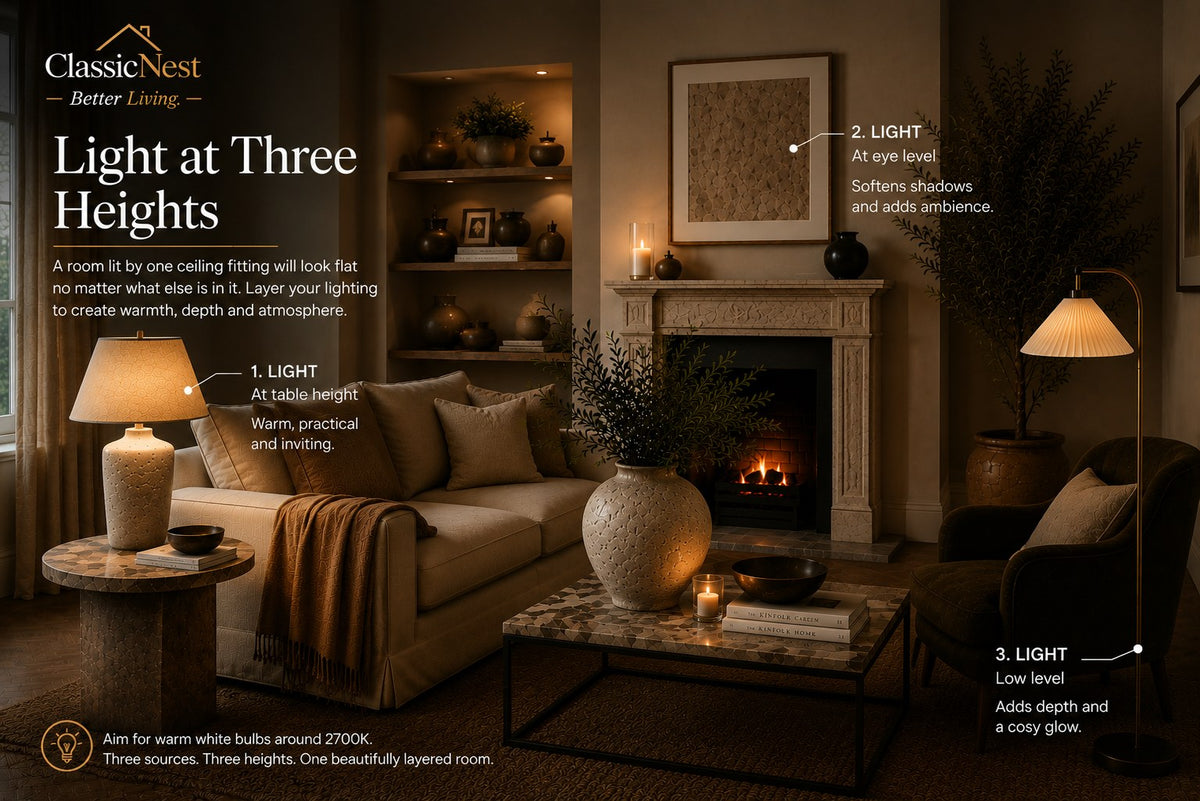
- Light at three heights. Overhead, at table height, and low. A room lit by one ceiling fitting will look flat no matter what else is in it.
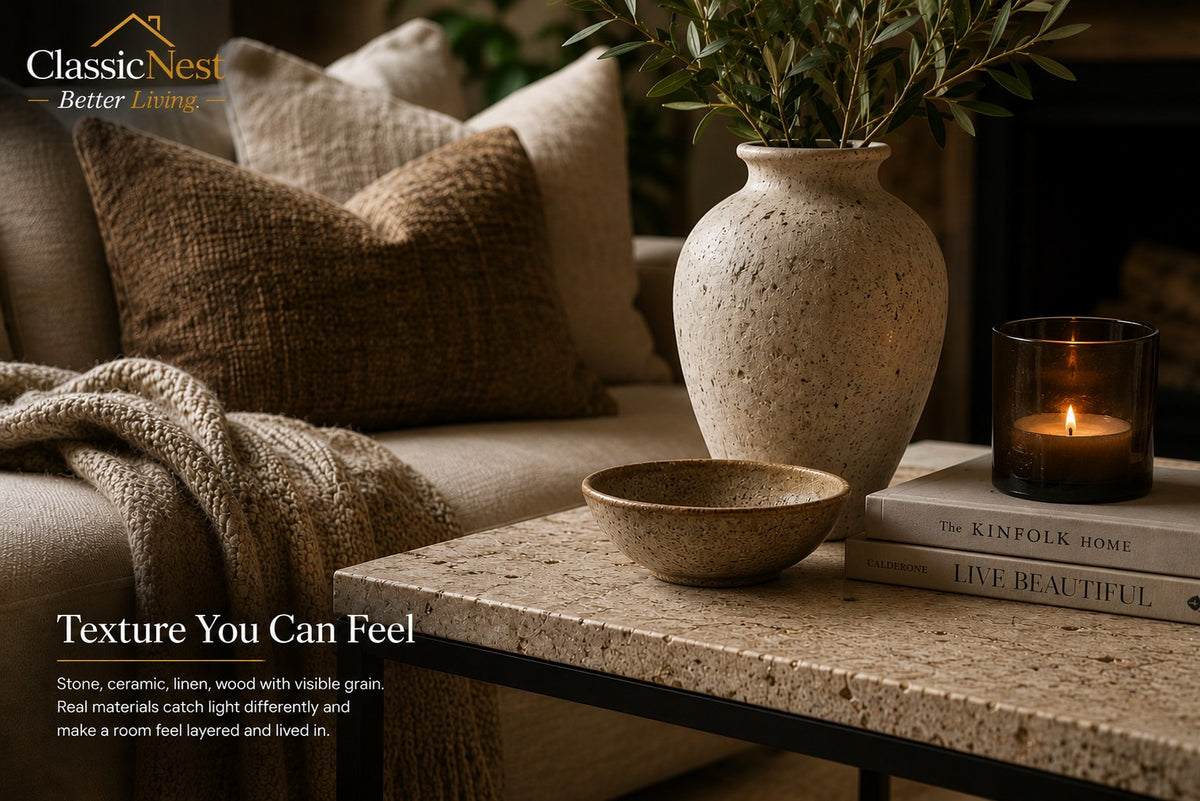
- Texture you can feel. Stone, ceramic, linen, wood with visible grain. Something that is not smooth and not painted.
- Something botanical. Real or faux, it matters less than people think. What matters is that one thing in the room has an irregular, organic shape.
- Art at eye level. One piece hung properly does more than four pieces hung badly.
Walk into your room and count. If you get to two, you have found the problem.
Layer one, light at three heights
Why one overhead light flattens a room
A ceiling fitting throws light downward at a single angle. Faces get shadowed under the eyes. The corners of the room go dark and stay dark. Everything reads as one flat plane, and your brain quietly files the space as somewhere to pass through rather than somewhere to be.
Add a second source at table height and something shifts straight away. You get pools of light instead of a wash. You get shadow, and shadow is what gives a room depth. Add a third low down, a floor lamp beside a chair or a small lamp on a low shelf, and the room starts to have volume.
Three sources is the minimum for a living room. Two will do in a bedroom. One is only ever enough in a hallway you walk straight through.
The practical version of this rule is easier than it sounds. You almost certainly already have the overhead. So you need to add two things, and one of them can go on a surface you already own.
Our Athena Aged Stone Tall Table Lamp With Linen Shade at £220.50 is a good example of the middle layer doing two jobs at once. It gives you light at table height and it gives you a stone base, which quietly ticks off layer two as well. Pieces that solve two layers are the ones worth spending on.
Getting the height right matters as much as choosing the lamp. If you are unsure what size to buy, our guide to what size table lamp you need has a sizing chart for bedside tables, sofa side tables, consoles and desks.
Warm light matters more in Britain than almost anywhere
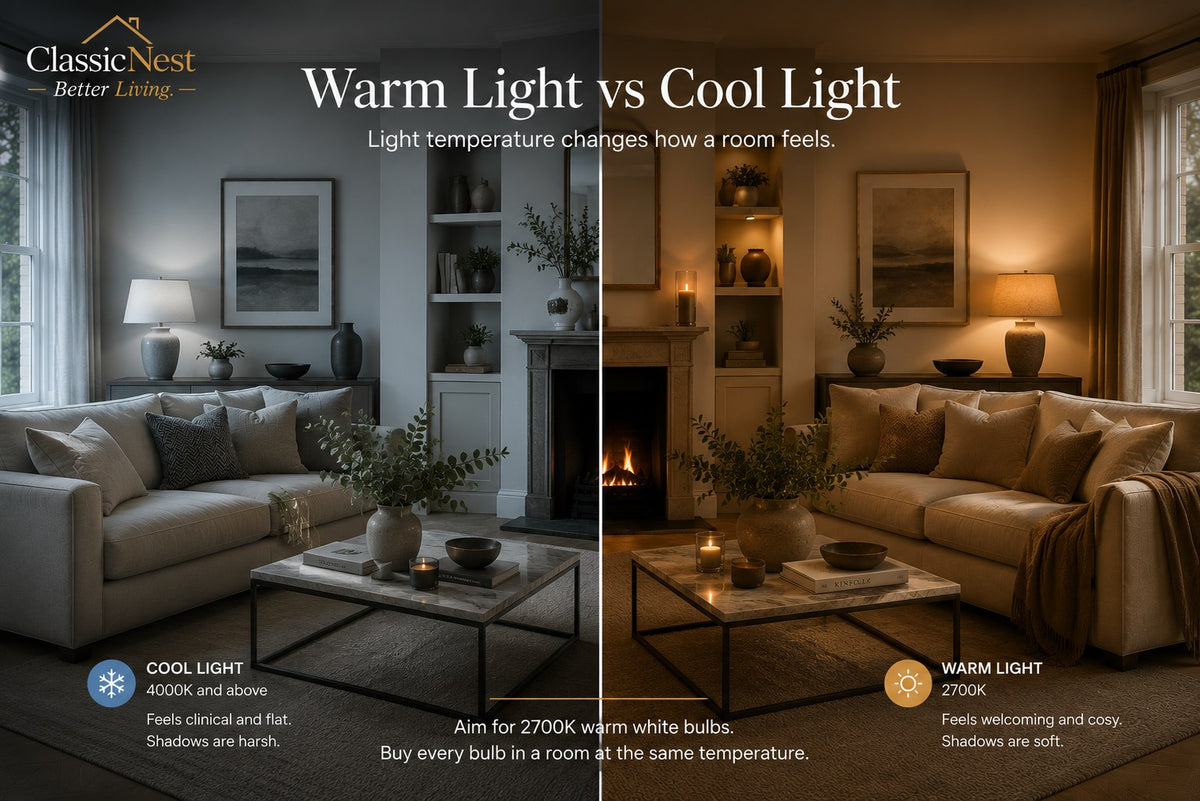
Here is something that gets overlooked in guides written for other markets. The UK gets very little daylight from November through to February, and what we do get is grey and diffuse. That means your artificial light is doing far more work here than it would in southern Europe, and the colour of it matters correspondingly more.
Aim for 2700K. That is the warm white end of the scale, the colour of an old filament bulb. Anything above 4000K reads as clinical and will make a beautifully decorated room feel like a waiting area.
Buy every bulb in a room at the same temperature. Mixing a warm lamp with a cool overhead is one of the most common reasons a room feels subtly wrong without anyone being able to say why.
Browse the full lighting collection if you are starting from one ceiling fitting and nothing else.
Layer two, texture you can actually feel
This is the layer most people skip, and it is the one that separates a room that looks styled from a room that looks bought.
Modern furniture tends toward smooth. Painted wood, powder coated metal, moulded plastic, flat weave fabric. All perfectly nice, and all reflecting light the same way. When everything in a room reflects light identically, the eye has nothing to catch on.
Four materials reliably fix this.
Stone and stoneware. Matte, slightly irregular, and it absorbs light rather than bouncing it. An Actium Shaded Sand Vase at £76.50 does more for a bare console than a painting would.
Ceramic with a visible glaze. Look for glazes that pool and vary rather than sitting perfectly even. The Aged Stone Tall Ceramic Vase at £99.00 has exactly that quality, and because it is tall it works standing on the floor as well as on a table.
Linen. Rumpled, not pressed. A linen lampshade softens light in a way a smooth shade cannot.
Marble and hard stone. Cold, heavy, and reflective in a completely different way to gloss paint. A Marble Ribbed Doorstop at £21.60 is the cheapest way I know to add real material weight to a room, and it earns its place by being useful.
One good textural object per surface is enough. Three on the same table starts to look like a shop display.
Layer three, something botanical
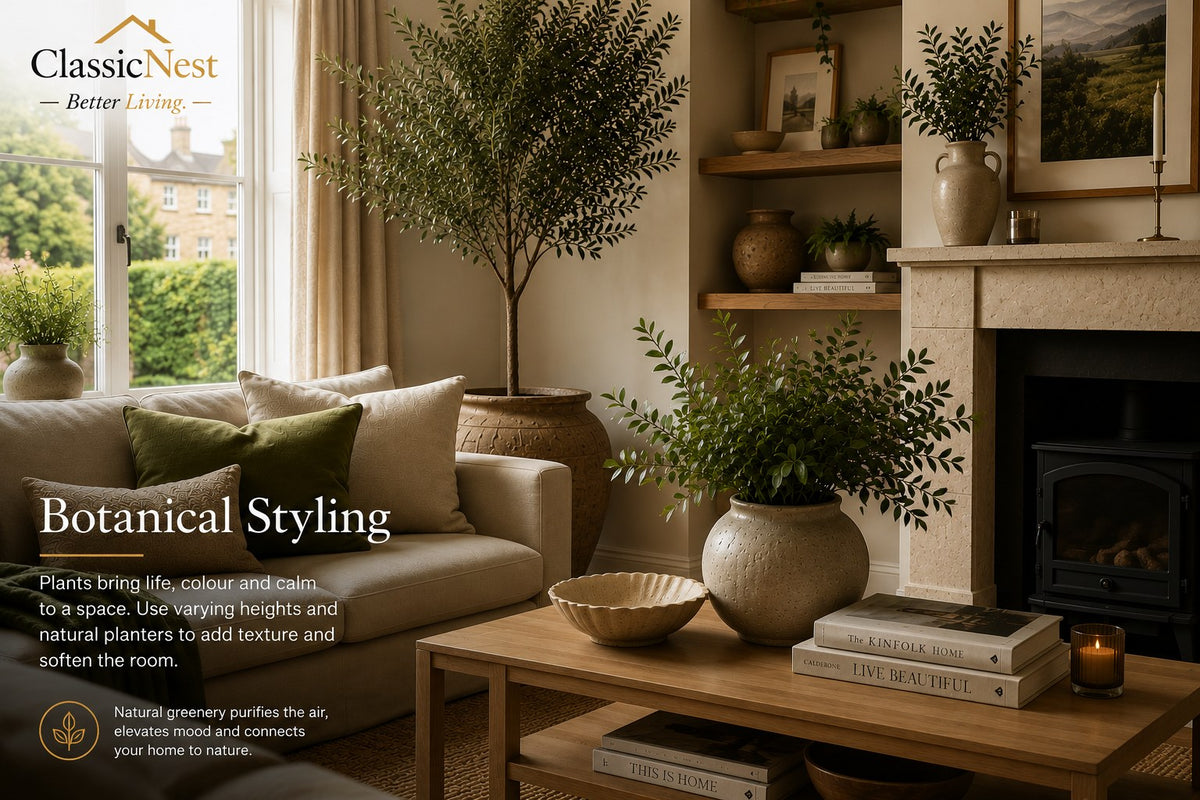
Every room needs one thing with an irregular shape. Furniture is rectilinear, walls are flat, and shelves are straight. Without something organic in the mix, a room reads as a diagram.
The real versus faux question is one people get anxious about, so let me be straightforward. Real plants are better if you will look after them. Most people will not, and a dying fern does considerably more damage to a room than a good faux stem ever could. UK homes in winter are also genuinely difficult for plants, with low light and dry heated air.
If you want the honest answer, put real plants where you already spend time and use faux where you do not. A kitchen windowsill gets real. A hallway console gets faux.
The trick with faux stems is restraint. A single type of foliage in a plain vase almost always looks better than a mixed arrangement, because mixed arrangements are where the plastic tells start to show. Silver Dollar Eucalyptus at £10.80 a stem is the safest thing in our range for this. Five stems, one vase, done. For something with more presence, a Bouquet Of Dried Protea at £13.46 reads as dried rather than fake, which sidesteps the problem entirely.
Group stems in odd numbers. Three or five. Even numbers look arranged, and arranged is the opposite of what you want.
Have a look through the artificial flowers collection if you want to see the range, and bear in mind that a stem costing under £15 is doing the same structural job in a room as a piece of furniture costing a hundred times that.
Layer four, art at eye level
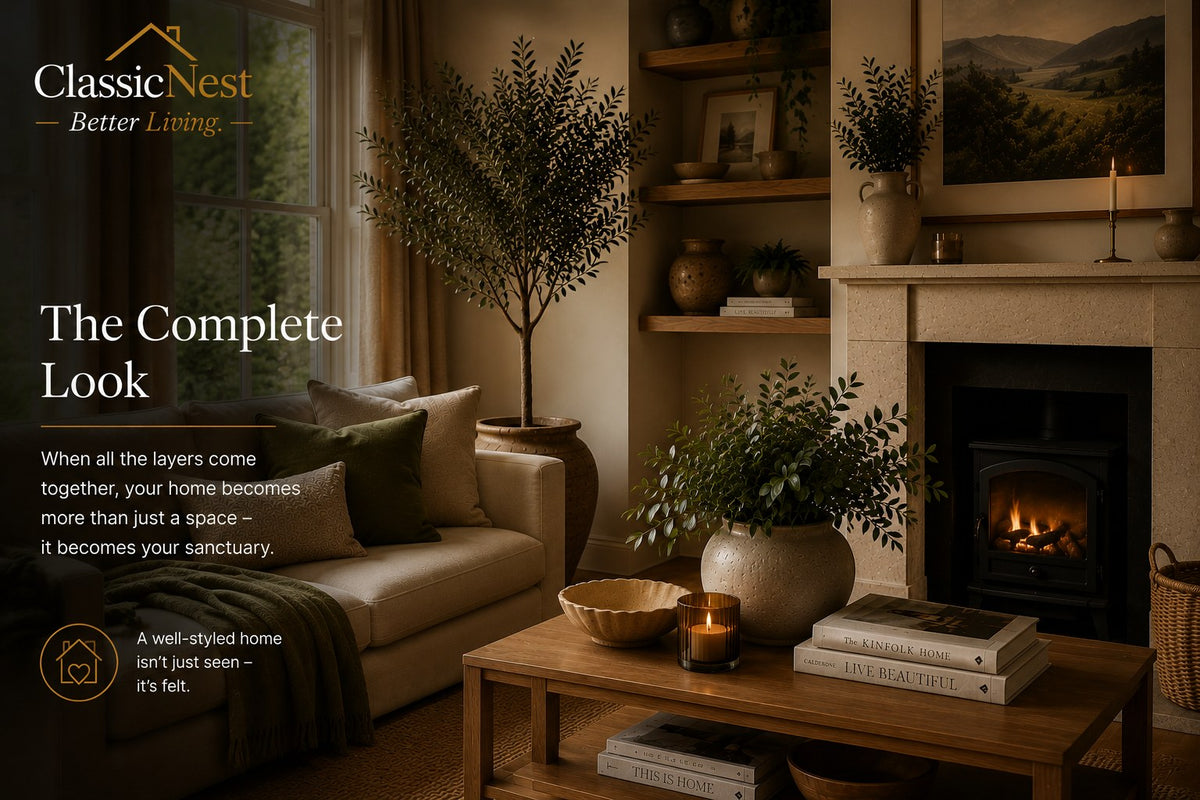
Most people hang art too high. This is so consistent that it is almost a rule of British homes.
The centre of a picture should sit at 145cm from the floor. That is average standing eye level for adults in the UK, and it is the number galleries use. If you are hanging above a sofa or a sideboard, come down to roughly 20cm above the top of the furniture instead, because art floating in isolation above a piece looks unmoored.
One larger piece beats three small ones. If you do want a group, treat the whole group as one rectangle and centre that rectangle at 145cm, keeping the gaps between frames tight at around 5cm.
An Alta White Feathers Art Mounted In Beaded Frame at £54.00 is a useful piece for this because the frame does some of the work. A beaded edge gives the wall something to catch light on, which matters in a room where the art is the only thing breaking up a flat surface.
Clocks count as art, incidentally, and they are underused. A Brooklyn Black And Gold Wall Clock at £306.00 anchors a wall the way a large canvas would, and it earns its keep in a way a canvas does not.
The rest of the home décor collection is worth a browse once you know which layer you are shopping for. That is the important part. Shop by layer, not by category.
Room by room, in sixty seconds each
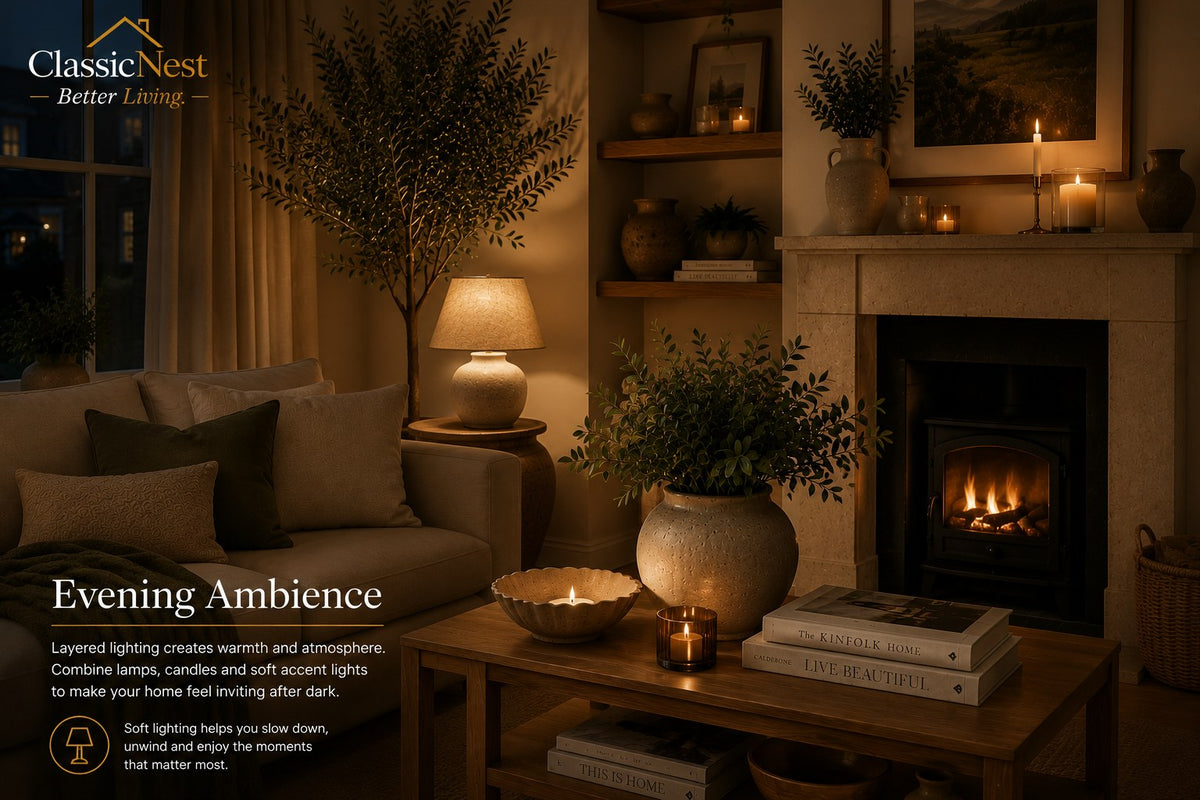
Living room. Three light sources minimum. One large textural object on the coffee table or a low shelf. One botanical piece, ideally somewhere you see it from the sofa. Art centred at 145cm, or 20cm above the sofa back.
Hallway. This is the room people ignore and it is the first thing anyone sees. A console table, one lamp, one vase with stems, one mirror or one framed piece. That is a complete hallway and it takes about twenty minutes to assemble. Keep the console under 40cm deep if the hallway is narrower than 1.2m.
Dining room. The light does the work here. Something hanging over the table at roughly 75cm above the tabletop, plus one other source so the room is not a spotlit stage when you are eating. A low centrepiece, because a tall one means guests talk around it rather than through it. Have a look at the tables collection if the room is not working and you suspect the table itself is the reason.
Bedroom. Two light sources is enough, and both should be low. Overhead lighting in a bedroom is unpleasant at the times of day you actually use the room. Texture matters more here than anywhere because you are close to everything.
The one shelf exercise
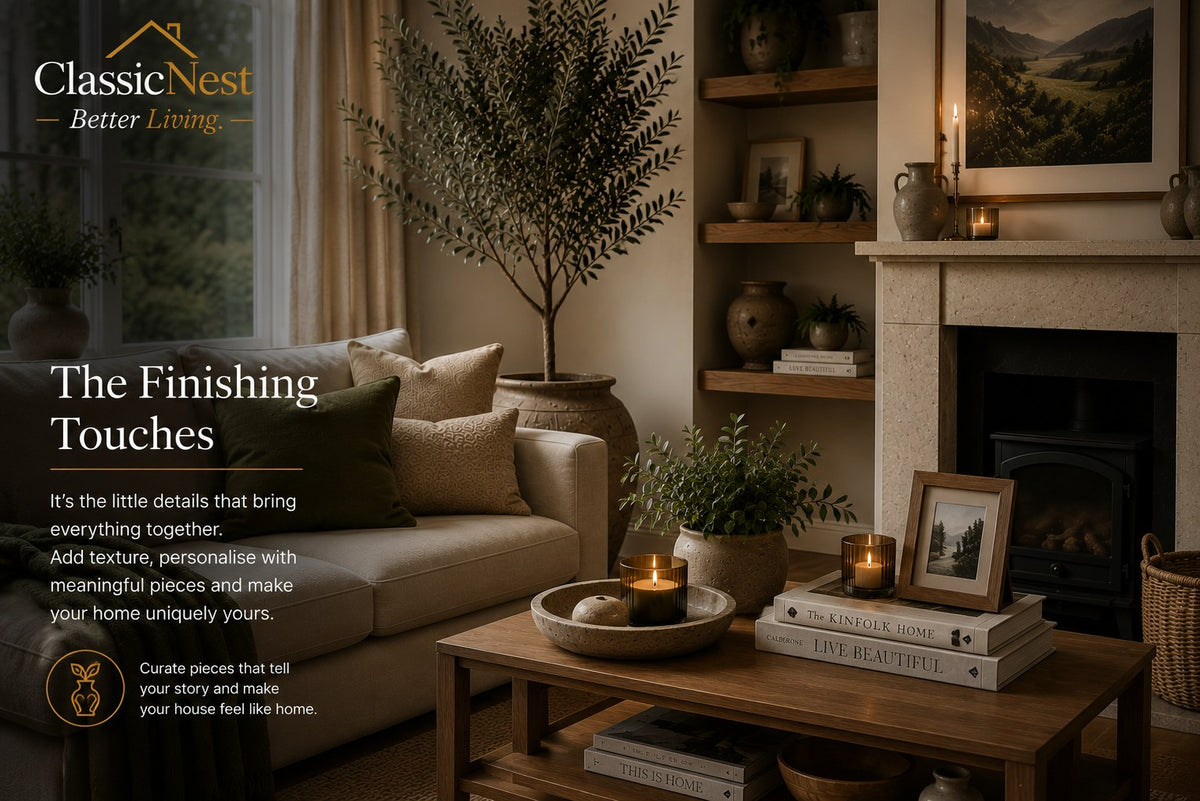
If all of this feels like a lot, do one shelf. It takes fifteen minutes and it teaches the whole method.
- Take everything off the shelf. Everything.
- Put back the largest object first, and put it toward one end rather than the centre.
- Add a second object of a clearly different height, and place it near the first rather than spaced evenly away from it.
- Add a third object, low and wide, to close the group into a triangle shape.
- Stop. Leave the remaining third of the shelf empty.
That empty third is the part people cannot bring themselves to do, and it is the part that makes it work. Space is what tells the eye that the arrangement was a decision rather than an accumulation.
Repeat on the next shelf with the group at the opposite end, so the eye zigzags down the unit rather than reading a straight line.
If you are doing this on open shelving and finding it hard, the unit itself may be the issue. Glass shelves like the Axis Shelf Unit With Glass Shelves at £166.50 are considerably more forgiving than solid ones, because light passes through and the objects are not competing with a heavy horizontal band. The full shelving collection is small but chosen with this in mind.
Where to start if you only do one thing
Add a lamp.
Of the four layers, lighting is the one that changes a room fastest and the one most people are missing. A single table lamp at the right height, with a warm bulb in it, will do more in an evening than a weekend of rearranging furniture.
Then texture. Then something botanical. Then art.
In that order, because each layer makes the next one easier to judge.
Frequently asked questions
How do you make a room look expensive on a budget?
Fix the lighting first, then add one genuinely textural object. Warm bulbs at 2700K across every fitting in the room, three light sources rather than one, and one piece of stone or ceramic on a surface. Those three changes cost very little and read as expensive because they are what expensive rooms actually do. Matching furniture sets and lots of small decorative items read as cheap regardless of what they cost.
What is the 60/30/10 rule in interior design?
It is a proportion guide for colour. Roughly 60 percent of a room in a dominant colour, usually the walls and large furniture, 30 percent in a secondary colour such as textiles and smaller furniture, and 10 percent in an accent colour. It is a useful starting point rather than a law, and it works best when the 60 percent is something quiet.
How many decorative objects should be on a shelf?
Three per group, in three different heights, filling about two thirds of the shelf. More than three and the group stops reading as a composition. If you have a long shelf, make two groups of three with a clear gap between them rather than spreading five objects evenly along it.
What height should pictures be hung at in the UK?
Centre the picture at 145cm from the floor, which is average standing eye level. Above furniture, hang so the bottom of the frame sits around 20cm above the top of the piece. For a group of frames, treat the whole arrangement as a single rectangle and centre that at 145cm.